I try to write my posts as unbiased as possible and recommend the products I consider to be useful and the best. I use affiliate links, this means that–at no extra cost to you–I can make a commission on a purchase you make after clicking on them. As an Amazon Associate I earn from qualifying purchases.
How to Calm a Hyper Puppy:
Trainer-Approved Steps to Teach ‘Settle’
Do you have a hyper puppy? Does he never stop jumping, biting, and playing? Puppies have tons of energy, they need exercise and attention, but they also need to learn how to settle down. Teaching your dog to “settle” on cue and to relax or calm down after an exciting activity are two incredibly important skills to work on with your new puppy.
Article Highlights:
How to Calm a Puppy Using Neuroscience
Does your hyper puppy never stops jumping, biting, or playing? You’re not alone! Puppies are built to explore, their curiosity and endless bursts of energy are how they learn about the world. But just like children, puppies also need to learn how to come back down after excitement. That “calming down” skill is part of what makes a confident, emotionally balanced adult dog, and it starts deep inside the brain. This guide will show you how to calm a puppy and teach the settle command step-by-step.
When your hyper puppy gets excited, plays, or gets startled, their body activates something called the HPA axis (the hypothalamic-pituitary-adrenal system). This system is the brain’s communication line with the body during stress or arousal. It releases hormones like cortisol and adrenaline, which raise energy levels and prepare the body for action. Over time, through healthy experiences, puppies learn how to turn that system off and return to calm, a process that builds emotional regulation.
In their first few weeks of life, puppies learn this skill from their mother. When the mother licks, nuzzles, and comforts her pups after excitement, she’s not just being affectionate, she’s literally training their HPA axis. Her touch and warmth release calming hormones that help the puppies’ systems recover faster after stress. This early “soothing feedback” teaches the brain that the world is safe and that calm always follows excitement.
When we bring a puppy home, we take over that role. Every time we help our puppy relax after play, gently pet them when they’re calm, or teach them to “settle,” we’re continuing that same biological training. We’re showing their developing brain how to balance the “go-go-go” chemicals with the “rest-and-repair” ones.
So, if your puppy seems hyper, don’t worry, it’s part of growing up! The key is to guide them in practicing calmness just as much as play. Teaching your puppy to settle on cue and relax after excitement builds a strong, resilient stress-response system, and a happier, more balanced dog for life.
What Not to Do When Trying to Calm a Hyper Puppy
It’s not always intuitive how to help a hyper puppy calm down. Many people instinctively yell, say “no,” or push the puppy away when things get too wild. Unfortunately, puppies don’t interpret those actions the way we intend. To them, loud voices and fast movements can sound like you’re joining the game, or worse, they can create confusion and frustration that make the excitement even stronger.
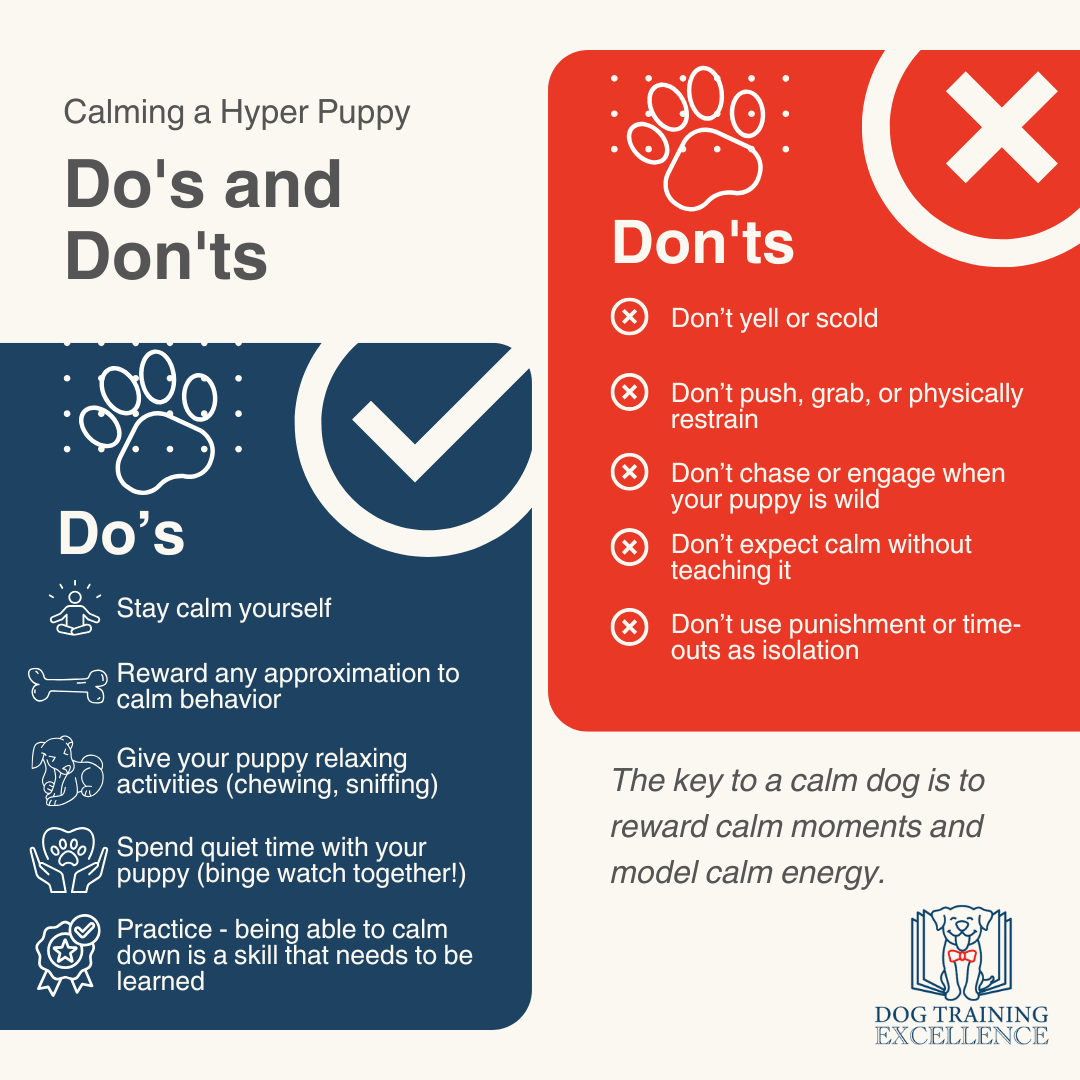
Here are some common “don'ts” to avoid when helping your puppy learn to settle:
❌ Don’t yell or scold
When you raise your voice, your puppy’s brain releases more adrenaline and cortisol, the same stress hormones that drive hyper behavior. This keeps the HPA axis (the stress-response system) activated and makes it harder for your puppy to calm down. Remember, calmness is contagious; your tone and energy set the emotional temperature of the room.
❌ Don’t push, grab, or physically restrain
Physical restraint can feel threatening or exciting, depending on the puppy. Either reaction fuels arousal instead of calming it. Puppies learn best through safety and gentle guidance, not through physical control. If you need to stop play, stand up, stay still, and wait for calm. Your stillness communicates far more than a grab ever could.
CAUTION!
Ignoring your hyper puppy for too long can cause more frustration than calmness. A good rule of thumb is to count to ten while you’re ignoring your puppy. If your puppy doesn’t calm down, does not walk away to find something else to do, or becomes even more excited then before, then ignoring might not be the right strategy for your pup.
Instead, try redirecting by exchanging toys that gradually encourage calmer play. For example, trade a ball for a plush toy, then trade the plush for a chew or licking toy your puppy can settle with. This helps your puppy shift from high-energy play to relaxation in a positive, guided way.
❌ Don’t chase or engage when your puppy is wild
If your hyper puppy is running off with socks or zooming through the house, chasing them adds fuel to the fire. They see it as a game! Instead, calmly redirect with a trade (“Let’s swap for this toy”) or walk away. Ignoring for a few seconds is sometimes the strongest “reprimand” your puppy needs, it removes the reward of your attention.
❌ Don’t expect calm without teaching it
Just like “sit” or “stay,” calmness is a behavior that must be taught and practiced. Puppies don’t automatically know how to self-soothe or relax after excitement, that’s where your training comes in. Use positive reinforcement, patience, and repetition to show them what calm looks and feels like.
❌ Don’t use punishment or time-outs as isolation
Short breaks (seconds) can be useful to help a puppy reset, but never send your puppy away in fear. Time-outs should feel like a chance to rest, not punishment. A cozy mat or crate with a chew toy can become a “relax zone” instead of a penalty box.
✅ What to Do Instead
Your two most powerful tools are your calm energy and clear communication.
When your puppy starts to settle, even for a few seconds, capture that
moment with a calm “yes,” a click, or a soft treat. Over time, your
puppy’s brain learns that stillness and relaxation lead to good things.
You can read more about these training strategies in the sections on Capturing and Clicker Training.
We are often aware when our hyper puppy is doing something bad, but as soon as he settles down we tend to ignore him…the opposite of what we should be doing!
Calm is a skill. Catch it, reward it, and watch it grow.
Following are the steps to teach your dog how to settle. However, remember to capture and reward (sometimes with food, sometimes with a gentle caress) every time you catch your pet being calm.
Teach the "Settle" Command: Step-by-Step
Goal:
Teach your hyper puppy that lying down calmly on their mat or bed makes good things happen. Learning how to teach the settle command is essential for every hyper puppy. It gives your dog a cue to relax, focus, and calm down after excitement.
What You’ll Need:
- A comfy mat or bed
- A few soft treats (low-arousal rewards like small bits of kibble or cheese)
- A quiet space with few distractions
Step-by-Step:
Trainer’s Tip:
Avoid using “Settle” as a correction when your puppy is overexcited. Instead, use it before things get wild, like right after a play session or when you see signs of restlessness.
- Choose the spot. Place the mat in a calm area of your home, not right next to the front door or where kids run by.
- Lure into position. Guide your puppy onto the mat with a treat. When they step or lie down on it, calmly say “Yes”, and give a treat.
- Give more treats. If you puppy remains laying down for 2-3 seconds, give them a few more treats. Treats should be placed on the mat right in between both front legs (this will make your puppy lower its nose to the ground to use his nose to find and eat the treats, and help him calm down.
- Practice. Practice the first 3 steps for a few days. You will notice that your puppy may follow the treat to the mat and lay down faster and faster.
- Add the cue. Once your puppy consistently lies down on the mat, softly say “Settle” right before you start the exercise. For example: "Settle" and bring your puppy to the mat, when puppy lays down you reward.
- More practice. It may take your puppy days or even weeks until he starts to make the association that "settle" means to go to the mat and settle. You will know your puppy is "getting it" when you say "settle" and puppy starts going to the mat without the food lure or you guiding him.
- Build duration. In the beginning, your puppy may get up as soon as you stop giving treats or when you stand up, and that’s OK! Let them. To gradually extend their settle time, start spacing out the treats. For example, if you began by giving treats every 1–2 seconds, now wait 3–5 seconds, then mix in random intervals between 1–10 seconds, then 5–20 seconds, and so on. The more unpredictable your timing, the more your puppy will learn to relax without expecting constant rewards. Give a treat only when your puppy is calmly lying down, not bouncing, pawing, or fidgeting. Gentle petting or quiet praise can also help reinforce that calm = good.
- Reinforce relaxation. Once your puppy can stay lying down for 5 to 10 seconds, start “capturing” relaxation states. For example, you might notice your puppy’s breathing slow down — reward! You might see them shift their weight and drop their hips to the side — reward! Or perhaps they lower their head to the ground — reward! By reinforcing these small signs of relaxation, you’re helping your puppy understand what “relax” really means.
- Fade out treats. Over time, try mixing calm petting or your soothing voice and food. Eventually, you may need a few treats to start the routine, but nothing else, you puppy will learn to settle and rest.
- Everyday practice. If you practice at least once every day, the cue itself (“Settle”) will start triggering the calm emotional state.
3 Games to Help a Hyper Puppy Relax
Game 1: Sniff to Calm
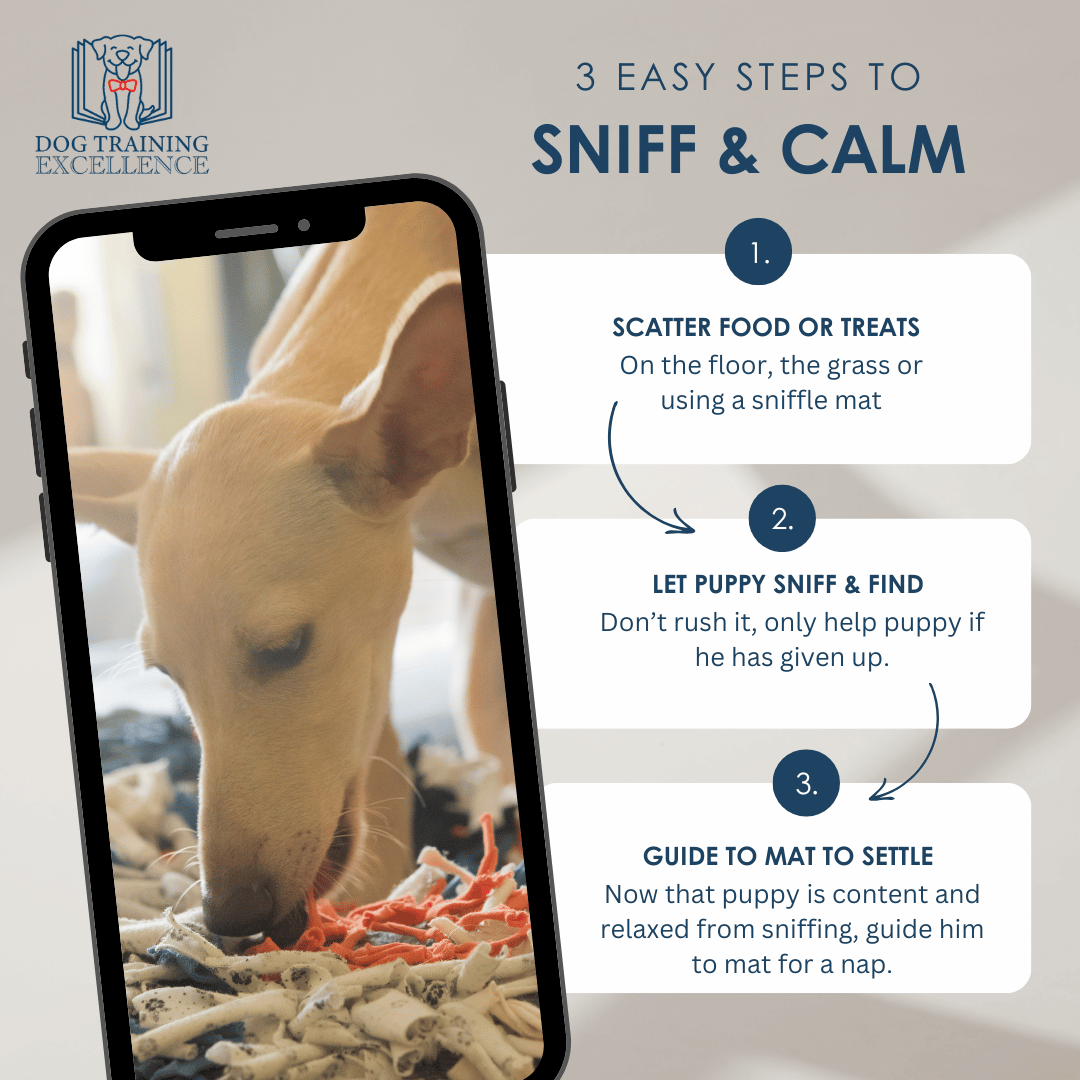
If your puppy has a hard time calming down after play or excitement, this routine will help them shift from zoomies to zen. Each step builds on natural canine behaviors, sniffing, chewing, and resting, to guide your puppy’s nervous system from high arousal to calm relaxation.
Step 1: Start with a Sniffing Game
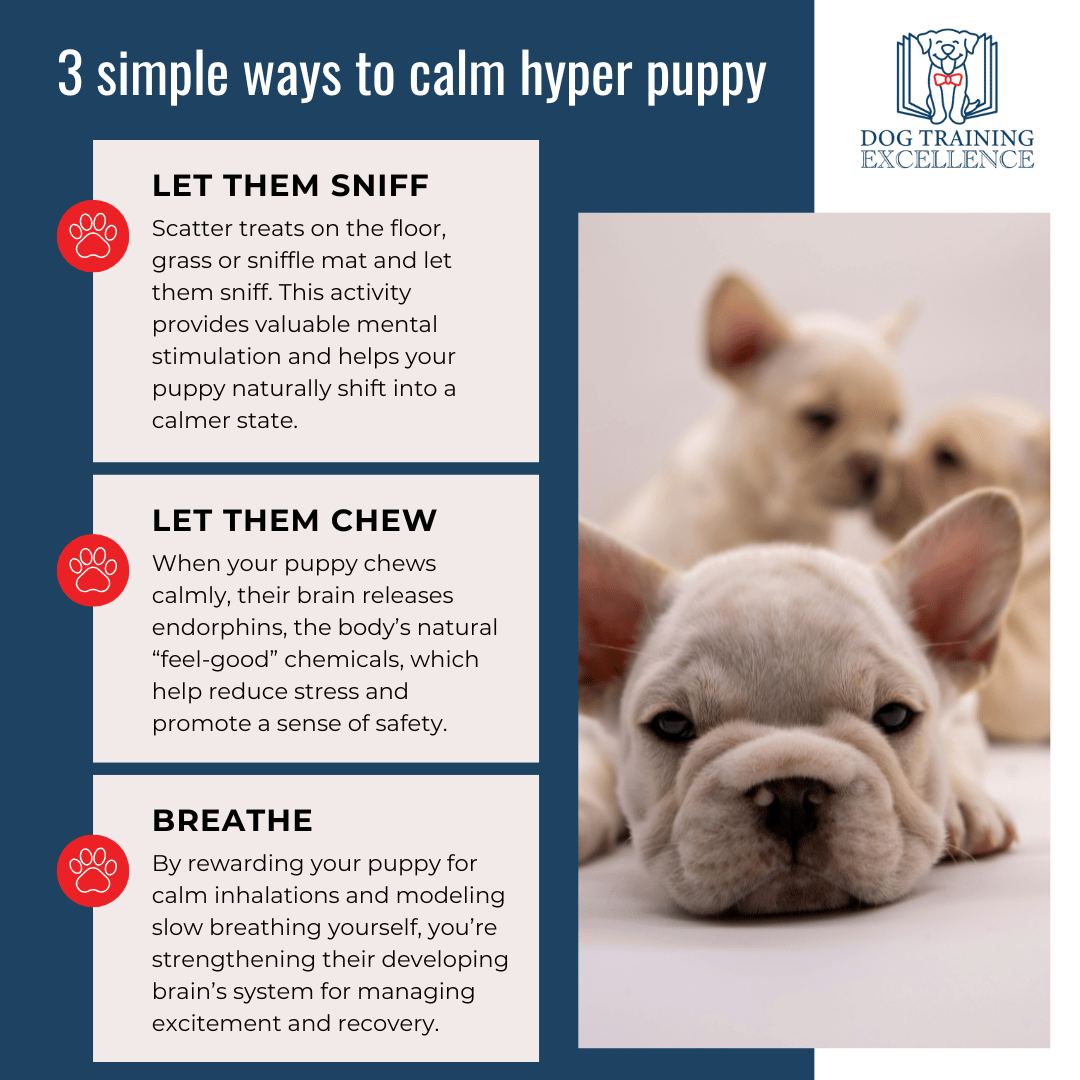
Scatter a few treats or pieces of kibble in a small area or on a snuffle mat. You can do this right in your home, simply drop the treats on the floor. In your yard, the grass adds an extra challenge, or you can use a snuffle mat for a more controlled activity.
If your dog has never used their nose to search before, start small. Drop the treats close together and help your puppy find them by gently pointing to any they’ve missed. As your puppy gets more savvy, you can gradually increase the search area.
Snuffle mats are a great option for small apartments or rainy days. They’re easy to use and provide lots of mental stimulation, which helps your puppy relax.
Step 2: Let Your Puppy Sniff Slowly
Let your puppy sniff out the treats without rushing. It’s important not to get impatient. Many dog parents want their puppy to find the treats right away, but that’s not the goal. The goal is for your puppy to use their nose and learn to search slowly and thoughtfully. Only step in to help if you notice your puppy has given up on the search. But if your puppy is still sniffing, let them!
This activity provides valuable mental stimulation and helps your puppy naturally shift into a calmer state. After your puppy finishes, they may even settle down on their own, that means your job is done!
Step 3: Guide Your Puppy to Rest
If your puppy doesn’t settle after sniffing, gently guide them to their mat with a food lure and practice the “settle” cue.
This is a great next step if your puppy is still a little too wound up and simply practicing “settle” alone hasn’t worked. The sniffing game lowers arousal first, making it easier for your puppy to succeed at relaxing.
Reward calm lying down, slower breathing, or any relaxed body posture. Over time, your puppy will associate these states with comfort and safety, the foundation for lifelong calm.
Recommended calming hacks
There aren’t many true hacks in dog training. In fact, we positive dog trainers are proud that the fewer “tools” we use, the better our technique is! No remote collars, no special leashes, nothing electronic, we can make magic with a clicker and some treats.
But I know you’re busy, or maybe you’ve brought home a specially energetic puppy. Below are three tools that may help calm a fearful or restless dog. However, please understand that there are no magic solutions. These may help you move the needle in your favor, but you’ll still need to practice the “settle” cue and play calming games with your puppy for lasting results.
1. DAP (Dog Appeasing Pheromone)
This pheromone is naturally secreted by a mother dog and has a calming effect on puppies. It’s available in several forms; I like the plug-in version for small rooms (like where your puppy sleeps) or the spray version to mist their bed. It’s non-toxic and has no effect on humans.
2. Calming Chews
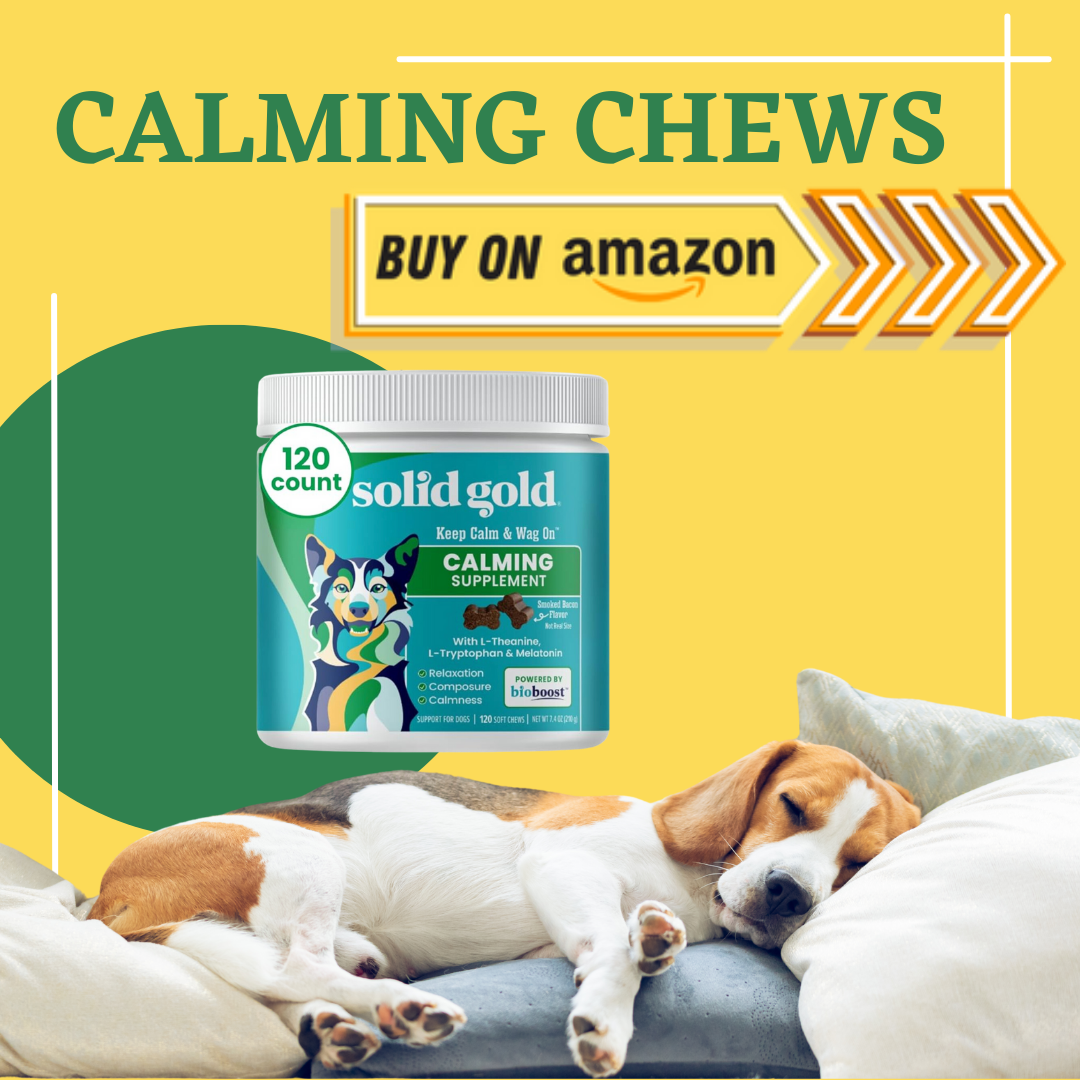
These chews contain gentle ingredients like melatonin and amino acids that help dogs relax. They can be useful during stressful situations, such as storms, fireworks, or short periods when your puppy must be left alone. I don’t recommend using them daily, but they can help on special occasions when your puppy needs extra support.
3. Thundershirt
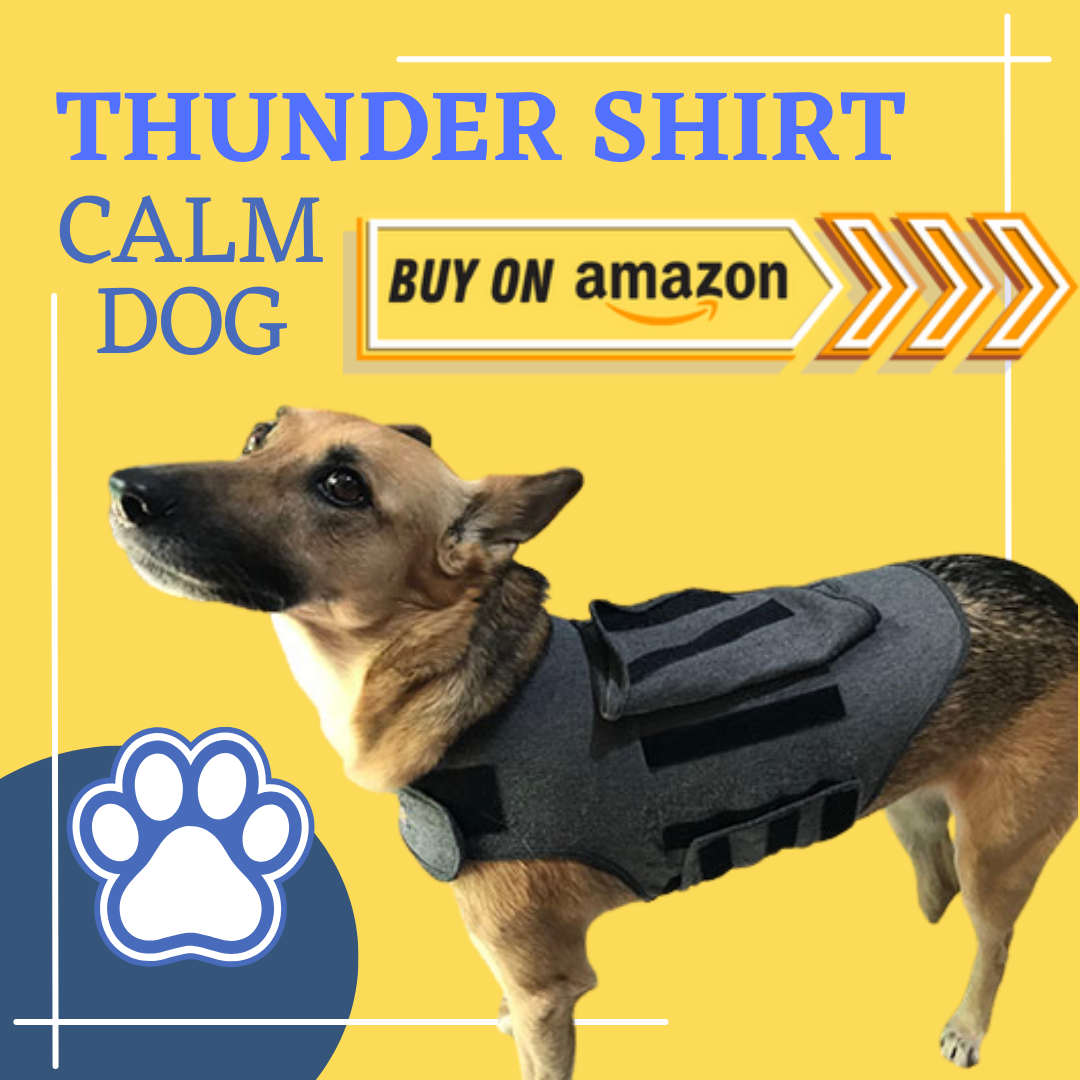
Some dogs feel calmer when gently wrapped in something snug. The Thundershirt was originally designed for dogs with fears of storms and fireworks, but it can also become part of a soothing bedtime or relaxation routine. Just give your puppy time to get used to wearing it gradually.
Don’t rush to buy everything at once! If you feel you need a little extra help, choose the option that best fits your lifestyle and try it for a couple of months. And remember, these tools can support your training, but they don’t replace it. Calmness is taught, not bought!
 |
 |
 |
Game 2: Chew to Chill
Chewing is one of a puppy’s most natural and effective ways to relax. It’s not just about keeping them busy, it’s a built-in self-soothing behavior that helps balance energy and emotions. When your puppy chews calmly, their brain releases endorphins, the body’s natural “feel-good” chemicals, which help reduce stress and promote a sense of safety.
This game helps your puppy practice relaxing with you nearby, turning chewing time into a peaceful bonding ritual.
Step 1: Offer a Safe Chew
Choose a long-lasting, appropriate chew such as a chew sticks, stuffed Kong, or frozen carrot. Make sure it’s safe for your puppy’s size and chewing style, the goal is calm, steady chewing, not frantic gnawing.
If your puppy tends to chew too quickly or gets overly excited, try giving the chew after some light play or a sniffing session to help them start in a more relaxed state.
Step 2: Encourage a Resting Position
Invite your hyper puppy to lie down while chewing. You can use a food lure to guide them to their mat or bed if needed. Calmly praise or mark the moment when they begin to chew while lying down, this reinforces that calm posture equals good things.
If your puppy gets up or moves around, that’s fine; gently guide them back to the mat without pressure. The goal is to associate lying down + chewing + calm with comfort.
Step 3: Model Calm Energy
While your puppy chews, sit quietly nearby. Avoid talking, touching, or moving too much. Your still presence helps your puppy feel safe and relaxed, you’re showing them that quiet time together is enjoyable.
You can even practice your own deep breathing or quiet reading while they chew, this turns the activity into a shared calm moment rather than just “puppy entertainment.”
Pair chew to chill with "settle"
If you find it hard to space out treats, and your hyper puppy gets up as soon as you do while practicing “settle,” try pairing the cue with a chew stick. Start the “settle” exercise as described above, but instead of giving a final treat, offer your puppy a chew stick. This encourages your puppy to stay on their mat or bed, calmly chewing, and often, they’ll eventually drift off for a nap. 💤
From Puppy Chaos to Calm — One Step at a Time!
Your puppy can learn to be playful AND calm!
Calmness isn’t a personality trait, it’s a skill your puppy can learn with you. Teaching your puppy to settle is a wonderful first step. But raising a happy, confident puppy also means teaching good habits, building communication, and helping your puppy learn when it's time to play, focus, or relax.
That's why I created NeoPuppy, my complete 8-week online puppy training program.
With 80+ short video tutorials, fun training games, and easy-to-follow exercises, you'll learn how to teach your puppy using positive, science-based methods—all at your own pace.
Choose the option that works for you:
- NeoPuppy Self-Paced — $149: The complete online puppy training program, available whenever you're ready to practice.
- NeoPuppy + Personal Coaching — $497: Everything in the self-paced program, plus four private online coaching sessions for personalized guidance.
Because a calm puppy isn't a puppy who never plays.
It's a puppy who's learning when to play and when to relax!
🐶 Click here to learn more about NeoPuppy
Game 3: Take a Breath
One of the simplest yet most powerful ways to help your puppy relax is by teaching them to “take a breath.” This exercise encourages self-regulation and connection, it helps your puppy slow down, focus, and feel safe in your presence.
Breathing slowly activates the parasympathetic nervous system, which lowers heart rate and reduces stress hormones like cortisol. By rewarding your puppy for calm inhalations and modeling slow breathing yourself, you’re strengthening their developing HPA axis, the brain’s system for managing excitement and recovery.
Step 1: Get Your Puppy’s Attention
Sit comfortably with your puppy in a quiet space. Hold a smelly treat (like a small piece of cheese or chicken) in front of their nose, but don’t give it yet.
You can have your puppy sit or simply focus on you. The goal is to get their attention without overexciting them.
Step 2: Wait for a Deep Breath
Watch closely for your puppy’s nostrils to flare as they take a slow, deep inhale through the nose.
This won’t happen while your puppy is panting, so wait for a calm moment when their mouth is closed.
As soon as you notice the inhale, softly say “yes” and give the treat along with calm praise. This teaches your puppy that deep breathing is rewarding and soothing. Repeat this step several times a day and for a few days.
Step 3: Add a Cue
Say "breathe" once, wait for your puppy's nostrils to flare and give a treat. Repeat several times a day for many days.

Breathe and emotional growth
Teach "breathe" in progressively challenging situations. Practice the same steps, always starting from the beginning, in progressively more challenging situations. For example, if your puppy likes to watch out the window and bark, sit with them near the window. When something happens outside, calmly give your puppy a treat, this helps them stay relaxed instead of barking immediately.
If you notice your puppy watching someone outside and their nostrils flare instead of barking, say “yes” and reward right away. You are rewarding the breathing behavior, which will help your dog to do it more often in these types of situations.
With practice, your puppy will learn to take a breath before barking, a small but powerful step toward emotional control and calm behavior.
Helping your hyper puppy learn calmness is one of the most valuable life skills you can teach. It’s not about stopping excitement, it’s about building emotional flexibility. A dog that can play, focus, and then relax is a confident, well-adjusted companion.
So next time your puppy sprawls out for a nap after play, smile, that’s neuroscience in action. 🧠💤
FAQs about calming a Hyper puppy
How to Calm a Puppy at Night (and Help Them Settle to Sleep Peacefully)?
How to Calm a Puppy at Night (and Help Them Settle to Sleep Peacefully)?
Bringing a puppy home is exciting but nighttime can be tough! Your puppy’s first nights away from their litter are often filled with confusion, restlessness, and even a little anxiety. Here’s how to calm a puppy on the first night and teach them how to settle and sleep calmly at night.
1. Create a comforting sleep setup.
Place your puppy’s bed or crate near where you sleep so they can hear and smell you. This helps them feel safe, just like being close to their littermates. Add a soft blanket or a safe toy that carries familiar scents.
2. Establish a calm nighttime routine.
About 30–60 minutes before bedtime, begin winding down. Dim the lights, play soft music, and avoid active play. A short walk, gentle petting, or a chew session can help calm your puppy to sleep.
3. Teach your puppy to settle at night.
Use the same “settle” cue from daytime training, paired with calm praise or a chew toy. Guide your puppy to their mat or bed, say “settle,” and reward quiet lying down. Over time, they’ll learn that “settle” means it’s time to rest.
4. Handle whining calmly.
If your puppy whines during the night, stay calm. Take them outside for a quick potty break if needed, then gently return them to bed without turning it into playtime. Consistency teaches your puppy that nighttime is for sleeping, not exploring.
5. Be patient, this is a learning phase.
I know you are asking yourself "How to calm down a puppy on the first night?", unfortunately, most puppies will take a few days to adjust to their new home and family, give your puppy this time, it's important. By combining structure, comfort, and calm energy, you’ll teach your dog to settle and sleep peacefully through the night.
How to calm a puppy down from biting?
How to calm a puppy down from biting?
Puppy biting is completely normal, but it can be frustrating! The key is to stay calm and redirect, not punish. When your hyper puppy bites your hands or clothes, exchange whatever they’re biting for an appropriate toy, like a soft plush, a chew stick, or a stuffed Kong. This teaches your puppy what’s okay to chew and what isn’t.
Remember, this takes many repetitions, swapping once or twice won’t fix it. It may take several days or even weeks for your puppy to start choosing their toys on their own. Every time you redirect calmly, you’re reinforcing good choices and helping your puppy learn self-control. Over time, those sharp little teeth will find the right outlets, and you’ll both enjoy calmer playtime.
How to calm a puppy down from crying?
How to calm a puppy down from crying?
Puppy crying is usually a sign of stress, loneliness, or confusion, especially in a new environment. The best way to calm your puppy down from crying is to offer comfort and structure, not punishment. Make sure your puppy’s needs are met first: potty, food, water, and a cozy place to rest.
If your puppy cries in the crate or at night, stay nearby and use a calm voice to reassure them. You can place the crate near your bed or offer a soft chew toy, like a stuffed Kong, to help them relax. Over time, as your puppy learns that being alone is safe, the crying will decrease. Remember, this is a learning process, your calm presence teaches your puppy how to self-soothe and settle peacefully.
How to calm a dog down instantly?
How to calm a dog down instantly?
There’s no true “instant” way to calm a dog, but you can help your dog relax more quickly by staying calm yourself. Speak softly, move slowly, and breathe deeply. Your calm body language communicates safety and helps your dog mirror your energy. Avoid yelling or sudden movements, which can increase arousal or stress.
Just as important: listen to your dog. If your puppy or dog can’t calm down, it may be a sign of stress, fear, or discomfort. Notice when it happens, is it always at the same time of day or in specific situations? These patterns can reveal what’s making your dog uneasy and help you address the real cause rather than just the behavior.
You can also redirect your dog’s energy into soothing activities, such as chewing on a safe toy, licking a stuffed Kong, or practicing the “settle” cue on their mat. Over time, these exercises, along with calming games like Sniff to Calm, Chew to Chill, and Take a Breath, create routines and positive associations that teach your dog how to relax on command. With patience and practice, your dog will learn that calmness isn’t something you force, it’s something you build together.
This article was written by Natalia Rozas, Ph.D. and Certified Professional Dog Trainer (CPDT-KA #4071465) and updated on October 27th, 2025. Case studies and anecdotes are real but to protect the privacy of our clients the names and details are changed.
- Home
- Puppy Training
- Hyper Puppy
OTHER ARTICLES YOU MIGHT LIKE
Potty Training a Puppy in a Week
Potty training a puppy can be the biggest nightmare if you do it incorrectly. Use positive methods to have your doggy housetrained in about a week. Find all the information you need right here!
Effective Puppy Crate Training Schedule (With Free PDF)
Is puppy potty training a nightmare? Solve it with this step-by-step guide and FREE printable puppy crate training schedule.
Crate Training an Older Dog the Positive Way
Crate training an older dog is easy with positive methods. Adult dogs take a little longer to learn that the crate is a safe place to relax and this step-by-step guide will help you along the way.


 |
 |
 |
 |